The Executions
The Executions constitute the single most violent rupture in the history of Animal Farm, the moment when the regime of Napoleon, having already silenced debate and expelled Snowball, openly turns its instruments of terror against its own subjects. In a single afternoon, a parade of confessions—extracted under the gaze of nine enormous dogs—ends with the throats of the accused torn out, and the principle that no animal shall kill another is effectively annulled. The event transforms the farm's moral landscape, replacing the solidarity of the Rebellion with a climate of fear in which even the most loyal are not safe.
Background and Buildup
The Executions do not emerge from nowhere. They are the culmination of a long campaign to construct Snowball as an omnipresent enemy. For months, every mishap on the farm—broken windows, blocked drains, lost keys, trampled seedbeds—has been attributed to Snowball's nocturnal visits. Napoleon has conducted theatrical inspections, snuffing the ground and declaring, "Snowball! He has been here! I can smell him distinctly!" at which his dogs growl and show their teeth. The animals have been thoroughly frightened, coming to feel Snowball as "some kind of invisible influence, pervading the air about them." Squealer has escalated the rhetoric, announcing that Snowball was "Jones's secret agent from the very start" and that documents prove he tried to lose the Battle of the Cowshed. Even Boxer, who witnessed Snowball's bravery, is brought to accept the accusation with his formula, "If Comrade Napoleon says it, it must be right." The groundwork of paranoia is complete.
The Purge Itself
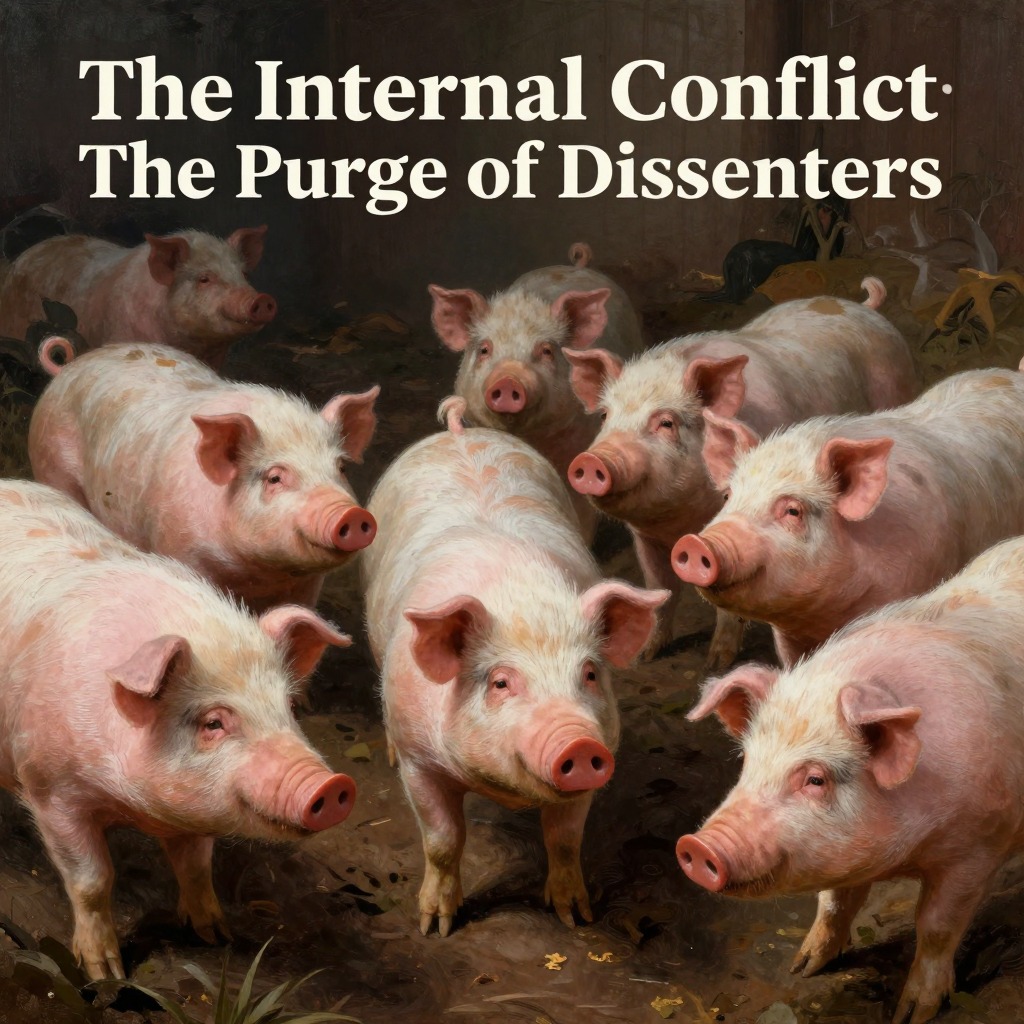
On a late afternoon, Napoleon orders all animals to assemble in the yard. He emerges from the farmhouse wearing both his self-awarded medals—Animal Hero, First Class and Second Class—with his nine huge dogs frisking around him, their growls sending shivers down every spine. The animals cower silently, seeming to know in advance that something terrible is about to happen. Napoleon stands sternly surveying his audience, then utters a high-pitched whimper. Immediately the dogs bound forward, seize four pigs by the ear, and drag them squealing to Napoleon's feet. The pigs' ears bleed; the dogs, having tasted blood, appear to go quite mad. Three of them fling themselves upon Boxer, who catches one in mid-air with his great hoof and pins it to the ground. The dog shrieks for mercy, and Napoleon, after a change of countenance, orders Boxer to let it go. The four pigs—the same ones who had protested when Napoleon abolished the Sunday Meetings—confess without further prompting: they have been secretly in touch with Snowball, collaborated in destroying the windmill, and agreed to hand over Animal Farm to Mr. Frederick. They add that Snowball privately admitted to being Jones's secret agent for years. When they finish, the dogs promptly tear their throats out. Napoleon then demands whether any other animal has anything to confess. The three hens who led the egg rebellion come forward, stating that Snowball appeared to them in a dream and incited them to disobey. They are slaughtered. A goose confesses to having secreted six ears of corn and eaten them at night. A sheep confesses to urinating in the drinking pool, urged by Snowball; two other sheep confess to having murdered an old ram by chasing him round a bonfire when he had a cough. They are all slain on the spot. The confessions and executions continue until a pile of corpses lies before Napoleon's feet and the air is heavy with the smell of blood—unknown on the farm since the expulsion of Jones.
Aftermath and Consequences
The remaining animals, except for the pigs and dogs, creep away in a body, shaken and miserable. They do not know which is more shocking: the treachery of those who leagued with Snowball, or the cruel retribution they have just witnessed. In the old days under Jones, there had been scenes of bloodshed equally terrible, but it seems far worse now that it is happening among themselves. Since Jones left, no animal had killed another—not even a rat. They make their way to the knoll where the half-finished windmill stands and lie down as though huddling for warmth: Clover, Muriel, Benjamin, the cows, the sheep, a whole flock of geese and hens—everyone except the cat, who had disappeared just before the assembly. For some time nobody speaks. Only Boxer remains on his feet, fidgeting and occasionally uttering a little whinny of surprise. He finally says, "I do not understand it. I would not have believed that such things could happen on our farm. It must be due to some fault in ourselves. The solution, as I see it, is to work harder." He moves off to the quarry, collects two loads of stone, and drags them to the windmill before retiring. Clover, looking down the hillside with tears in her eyes, thinks that this was not what they had aimed at when they set themselves to overthrow the human race. She had pictured a society of animals set free from hunger and the whip, all equal, each working according to his capacity, the strong protecting the weak—as she had protected the lost brood of ducklings on the night of Old Major's speech. Instead, they have come to a time when no one dares speak his mind, when fierce growling dogs roam everywhere, and when comrades are torn to pieces after confessing to shocking crimes. Yet she knows they are still better off than in Jones's day, and that above all else the return of human beings must be prevented. She and the others begin to sing 'Beasts of England'—three times, slowly and mournfully, in a way they have never sung it before. Squealer, attended by two dogs, approaches and announces that by a special decree of Comrade Napoleon, 'Beasts of England' has been abolished. "The Rebellion is now completed," he says. "The execution of the traitors this afternoon was the final act." The sheep break into "Four legs good, two legs bad" and put an end to any discussion. The song is heard no more; in its place, Minimus's new composition is sung every Sunday morning, but neither its words nor its tune ever seem to the animals to come up to 'Beasts of England'.
The Rewriting of the Commandments
A few days later, when the terror has died down, some animals remember—or think they remember—that the Sixth Commandment decreed "No animal shall kill any other animal." Though no one cares to mention it in the hearing of the pigs or dogs, it is felt that the killings do not square with this. Clover asks Benjamin to read the Sixth Commandment; he refuses, saying he will not meddle in such matters. She fetches Muriel, who reads: "No animal shall kill any other animal WITHOUT CAUSE." Somehow the last two words had slipped out of the animals' memory. They see now that the Commandment has not been violated, for clearly there was good reason to kill traitors who leagued with Snowball. The alteration—whether by actual erasure and rewriting or by the gradual erosion of collective memory—is complete. The principle that had distinguished Animal Farm from the human world it replaced has been hollowed out while appearing to remain intact.
Thematic Significance
The Executions mark the point at which the revolutionary project of Animal Farm fully inverts into the very tyranny it was meant to overthrow. Old Major's founding commandment—"No animal must ever tyrannise over his own kind. Weak or strong, clever or simple, we are all brothers. No animal must ever kill any other animal"—is now dead in practice, preserved only in a text that has been silently amended to permit murder. The purge also completes the transformation of Snowball from a rival into a demonic figure whose imagined presence justifies any atrocity. The animals' inability to protest, their acceptance of the rewritten Commandment, and Boxer's response—to work harder—demonstrate how thoroughly the regime has internalized obedience. The executions are not merely a punishment of the guilty; they are a ritual of power that terrorizes the innocent into submission, and they pave the way for every subsequent abuse: the abolition of 'Beasts of England', the cult of Napoleon, the final erasure of the Seven Commandments themselves.